How to Escape Prison in BitLife: 7 Map-Solving Rules
A practical prison escape guide for reading guard movement, using walls, solving 8x8 and 7x5 layouts, and avoiding failed escape attempts.

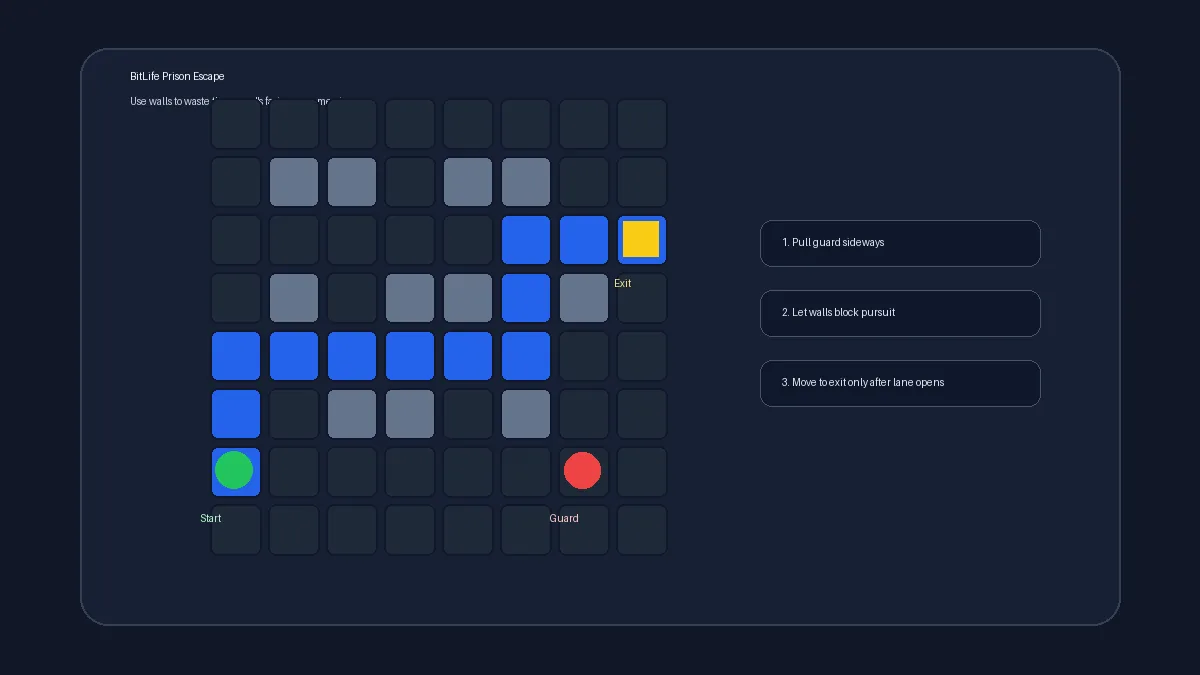
Prison escape is one of the most searched BitLife side goals because it is not solved by stats, money, or luck alone. Once your character is in jail, the escape screen becomes a small grid puzzle. The guard reacts to every move, and a route that looks open can fail if it gives the guard a direct lane to catch you.
This guide focuses on the puzzle logic behind BitLife prison escape instead of pretending there is one universal map answer. Search data shows players look for how to escape prison in BitLife, BitLife prison escape 8x8, 7x5 layouts, and solver-style help. Those searches have a distinct intent from our general BitLife guide, career guides, and BitLife Unblocked homepage: the user wants a tactical method for one jail mini-game.
Understand the Guard Rule Before You Move
The most important idea is that the guard moves faster than you. In many BitLife prison layouts, the guard effectively gets two movement opportunities after your single move. That means open space is dangerous. If you walk across a long corridor without using walls, the guard can close the distance even when you started several squares away.
The safer approach is to treat the guard like a piece that must be redirected. Walls, corners, and blocked cells can waste the guard's movement. Your goal is not just to reach the exit; it is to make the guard spend its faster movement on a path that cannot intercept your next step.
Before moving, scan three things: where the exit is, which walls can delay the guard, and whether your first move pulls the guard into a trap or into an open lane. If the first move gives the guard a straight line, restart your plan mentally before committing.
Best first habit
Pause before the first move and plan two turns ahead. A slow planned route beats a fast direct route because the guard is faster than your character.
A Repeatable Method for 6x6, 7x5, and 8x8 Escapes
Use this method when you do not have the exact map solution in front of you. It helps you reason through most prison layouts without guessing.
- Mark the exit lane - Identify the last two or three squares before the exit. If the guard can stand on one of those squares before you arrive, the route is not ready.
- Find the nearest wall trap - Look for a wall, corner, or narrow passage that can force the guard to walk around while you move toward the exit.
- Pull the guard sideways first - Many escapes start by moving away from the exit for one turn. This can drag the guard into a bad lane and open the route you actually need.
- Move only when the next square is safe - Do not judge only your current square. Ask where the guard will be after its faster response.
- Use backward solving on large maps - For 8x8 layouts, imagine the final path from the exit back to your start. This reveals which walls must block the guard before the final sprint.
- Reset if the guard gets a direct corridor - If the guard can chase you down a straight open path, stop using that line and rebuild the route around obstacles.
A clean route usually pulls the guard into a wall or corner before the final move toward the exit.
How Map Size Changes the Escape Plan
Players often search for a specific map size because the puzzle feels different on each layout. The same guard logic applies, but the planning depth changes.
| Map size | Best fit | How to solve |
|---|---|---|
| 6x6 prison | Quick escape or early jail layouts | Use the closest corner quickly. There is less room to recover from one wrong move. |
| 7x5 prison | Medium layouts with short corridors | Pull the guard sideways, then use a wall edge to create one clean exit lane. |
| 8x8 prison | Maximum-security style searches | Plan backward from the exit and expect at least one move away from the exit before the real route opens. |
| Solver-style route | When a map looks impossible | List your moves as a sequence and test where the guard lands after each one instead of changing direction randomly. |
Common BitLife Prison Escape Mistakes
Most failed escapes come from treating the puzzle like a normal maze. It is a chase puzzle, so the guard's response matters more than the shortest path.
- Running straight to the exit - A direct route often gives the guard the same open lane with more movement.
- Ignoring the guard's second step - A square can look safe after one guard move and still fail after the full response.
- Moving into open center squares - The middle of the board gives the guard too many angles. Edges and walls are usually safer.
- Changing the plan every turn - Random zigzags rarely solve 8x8 maps. Keep a route and adjust only when the guard position proves it unsafe.
- Escaping during the wrong life plan - A prison escape can fit a chaos or crime run, but it can ruin clean careers, business plans, and family legacy runs.
Watch a BitLife Prison Escape Example
A video walkthrough is useful because the timing is easier to understand when you see the guard react after each move. Use it as visual practice, then apply the rule-based method above to the layout you get.
Embedded video is a gameplay reference from YouTube. The written method on this page remains the primary guide, so the answer is crawlable even if the video is unavailable.
BitLife Prison Escape FAQ
Sources and useful references
- Official BitLife support center BitLife Help Center
- Official app listing BitLife on Google Play
Last updated: June 18, 2026